Highlights
- One codebase serving five audiences on three domains, with tenants resolved by subdomain
- Native Apple Wallet and Google Wallet passes that update on the shopper's phone when a coupon is used
- Per-venue Twilio subaccounts with UK and US messaging compliance built into the sign-up flow
- Stripe subscriptions with plans, add-ons, usage-based overage, revenue-share pricing and free pilots
- AI built into the product (Anthropic's Claude) and AI-assisted engineering throughout the build
- A built-in sales and outreach CRM, so the business behind the product runs on the product
The idea
Between 2014 and 2017 I worked on a coupon platform for shopping centres in Norway, as a front-end developer at a mobile messaging company. The idea stayed with me: centres attract thousands of visitors every day but rarely own a direct line to them, and the shops inside them have no simple way to bring those visitors through their doors.
VouchrPulse is my take on that problem, built from the ground up for how people shop now. Shoppers don't want an app. They already have SMS, WhatsApp and a wallet on their phone, so VouchrPulse uses all three.
The challenge
A product like this has to work for several groups of people who want very different things.
- Shoppers need to sign up in seconds, get offers that are relevant to them and use them without friction.
- Shop managers need to publish offers and see what they bring in without learning a marketing tool.
- Centre managers need to run campaigns across the whole centre and prove the value to their retailers.
- Mall groups that own several centres need a view across all of them.
- I need to sell, bill, support and monitor the platform as a one-person business.
Underneath that sit some hard technical constraints. Messaging is regulated: UK and US carriers require identity checks for each sending business. Wallet passes are governed by Apple's and Google's own protocols and signing rules. Money changes hands through subscriptions, add-ons and usage. And every venue's data must stay strictly separate.
One platform, five audiences, three domains
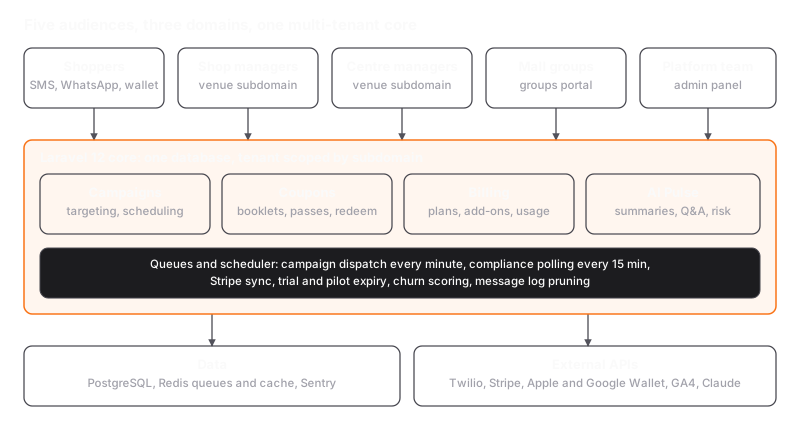
A single Laravel 12 application serves everyone, with routing bound to three domains:
{venue}.vouchrpulse.comcarries each venue's dashboard for centre and shop managers, and the public shopper pages (sign-up, booklet, redemption).groups.vouchrpulse.comis the portal for mall groups, with cross-venue analytics, manager invites and bulk venue import.admin.vouchrpulse.comis my internal back office for venues, plans, pricing, forecasting and sales.
Multi-tenancy uses Spatie's Laravel Multitenancy package on one shared
PostgreSQL database. Venue-scoped models carry a global scope that
filters every query by the current tenant automatically, and queued
jobs restore the right tenant when they run. Data isolation doesn't
depend on a developer remembering a where clause.
The dashboards are a Vue 3 and Inertia.js single-page app with PrimeVue and Pinia. The shopper pages are deliberately lightweight Blade and Alpine.js, because they open from a text message on a phone with a weak signal and have to load instantly.
The shopper journey
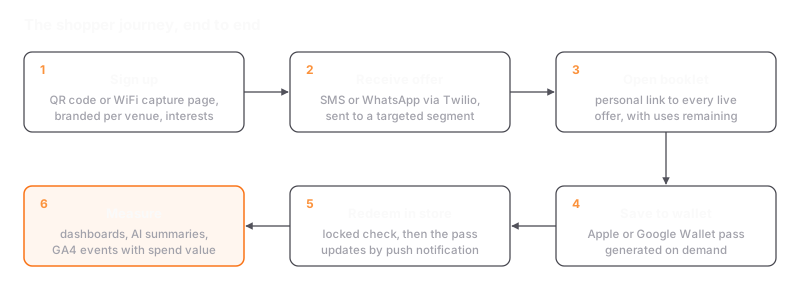
- Sign up from a QR code or the centre's WiFi portal. Each venue's capture page takes on its brand colour, and the theme switches between light and dark by calculating the colour's luminance, so text always stays readable. Shoppers can pick their interests at sign-up.
- Receive an offer by SMS or WhatsApp. WhatsApp messages use approved Twilio Content Templates, with a branded variant that shows the venue's logo as an image header.
- Open a personal booklet of every live offer, showing which ones they have used and how many uses remain.
- Save to Apple Wallet or Google Wallet with one tap. Passes are generated on demand.
- Redeem in store. Redemption runs inside a database transaction with a row lock, so a double tap, or staff and shopper tapping at the same moment, can never record a coupon twice. The wallet pass then updates itself on the shopper's phone.
- Measure. Every sign-up and redemption feeds dashboards, AI summaries and, optionally, the venue's own Google Analytics 4 property.
Native Apple Wallet and Google Wallet
I built wallet pass generation in-house instead of paying a pass vendor.
- Apple Wallet: signed
.pkpassfiles, plus a full implementation of Apple's PassKit web service protocol for device registration, pass updates and change logs. When a coupon is redeemed or a multi-use offer counts down, the server sends a silent APNs push and the pass refreshes on the shopper's phone with its new "uses remaining" or "redeemed" state. - Google Wallet: passes are issued through the Google Wallet API using a service account. Google's save and delete callbacks are verified cryptographically against Google's published root keys, checking the signing chain, expiry and issuer before any event is trusted.
The platform doesn't just know that a coupon was sent. It knows when a shopper saved it to their phone, and when they removed it.
Messaging and compliance with Twilio
SMS and WhatsApp run on Twilio, and this is one of the most involved parts of the platform.
- A Twilio subaccount for every venue. A venue that wants its own dedicated number gets its own subaccount, created on demand, with encrypted credentials stored against the venue. Its sending identity and reputation are kept separate from every other venue.
- Regulatory compliance built into the product. A multi-step wizard collects the identity details each country requires. For the UK this is a Regulatory Compliance bundle through Twilio Trust Hub. For the US it is 10DLC Brand and Campaign registration. Nobody has to fill in a carrier form by hand.
- Approval-aware number purchasing. A number can't be bought until compliance is approved, so the platform records the purchase intent and waits. A scheduled job polls approval status every 15 minutes, with a status callback as a faster signal. Once approved, a queued job buys the number in the venue's subaccount, invoices it through Stripe and, for the US, submits the 10DLC campaign now that it has a number to attach it to.
- Smart opt-out handling. The opt-out footer adapts to the sender. A real number gets "Reply STOP". An alphanumeric sender ID, which can't receive replies, gets a short self-service unsubscribe link on a dedicated short domain instead, because every character of an SMS is billed.
- Signed webhooks. Inbound messages and delivery receipts are verified with Twilio's request signatures before they are processed.
Stripe billing
Venues, not individual users, are the billing entity, using Laravel Cashier on top of Stripe.
- Plans and add-ons (dedicated SMS and WhatsApp numbers, extra message credit) are managed from the admin panel and synced to Stripe products and prices, so pricing changes need no code release.
- Usage-based overage reporting for messages beyond a plan's allowance.
- Revenue-share plans as an alternative to a flat fee, with per-venue rate overrides and an optional monthly cap.
- Free pilots with credit, extension and expiry. When a pilot ends without a plan, the venue drops to read-only access instead of losing its data, and I get an email about pilots ending soon.
- Subscription migrations that move venues between price versions in bulk.
- Webhooks plus nightly reconciliation, so local subscription state stays correct even if a webhook is missed.
Analytics and Google Analytics 4
Each venue sees redemption rates, campaign performance, shop-level results and subscriber activity in its dashboard. Venues that already use Google Analytics can connect their own GA4 property in settings. Sign-ups, wallet saves and redemptions are then sent server side through the GA4 Measurement Protocol, using the agreed average spend as the event value on revenue-share plans. Shop links carry UTM tags automatically, so the centre's marketing team sees VouchrPulse traffic in the reports they already use.
Analytics calls are written so they can never break a sign-up or a redemption. If Google is slow or down, the shopper never notices.
Campaign targeting
Campaigns can go to everyone who opted in, or to a segment: shoppers who redeemed at a particular shop or category, optionally within the last N days. New subscribers with no history can still be reached through the interests they chose at sign-up. Campaigns can be scheduled, and a dispatcher runs every minute to send them on a priority queue.
The admin back office and sales pipeline
Because I am the whole company, the admin panel runs the business as well as the platform.
- Venue and group management: onboarding, plan assignment, custom enterprise and revenue-share pricing, pilot activation and credit grants.
- Financial forecast: revenue, Twilio cost and margin for the last week, month, six months or year, compared with the period before and projected forward from the trailing 30-day run rate.
- Demo request inbox: the "Book a 15-minute call" form on the marketing site, protected by hCaptcha, lands here with a contact timeline and notes.
- Outreach CRM: prospects I contact myself move through a pipeline from New to Contacted, Follow-up sent, Meeting booked, Pilot offered, Pilot started and Won. The stage moves forward automatically when I send an email, and follow-up dates are set for me.
- Email composer with templates: reusable sales templates with placeholders. The composer refuses to send if any placeholder such as
[Mutual contact]is still in the text, and every link is tagged with UTM parameters so I can see which email brought a prospect to the site. - Private presentation links: each venue I pitch gets its own link to an in-person presentation. When a matched link is opened I get an email. Link-preview bots from email scanners and chat apps are filtered out, and a guessed or expired link quietly shows the generic version, so it gives nothing away.
- Live sidebar badges for new demo requests and follow-ups that are due.
The shop manager area and group portal
Shop owners get their own area within the venue's dashboard. They can publish offers, run campaigns for their shop, see their redemptions and view their own analytics, without seeing other shops' data. Mall groups get a separate portal with analytics across all their venues, their own manager accounts and spreadsheet import for adding venues in bulk.
AI in the product
VouchrPulse uses Anthropic's Claude through its API, under one firm rule: the model writes words, the code does the maths. Claude is never given database access and is never asked to produce a figure.
- Campaign summaries. Claude writes a two or three sentence plain-English summary of how a campaign performed, for a centre manager who doesn't want to read a table. It works only from numbers the platform has already calculated, and is told never to invent or estimate a figure. Summaries are cached and only regenerated when new deliveries, redemptions or edits arrive, which keeps cost and latency down.
- Ask your data. Managers can type a question about their results in plain English. Claude answers using only a pre-computed snapshot of the venue's aggregates, so every number in the answer comes from a real calculation.
- Redemption predictions. While a campaign is still a draft, the platform predicts its likely redemption rate from past campaigns. It starts from the most specific history (this shop, this discount type) and falls back to broader groups until there is enough data to trust.
- Churn risk. A nightly job flags subscribers who are "going quiet" by comparing the time since their last redemption with their own usual gap between redemptions. This one is a deliberate heuristic with no AI involved, because a transparent rule is easier to explain to a client.
AI-assisted engineering
The platform was built by one developer in eight months, and that pace was only possible with AI as a working partner. I used Claude Code throughout the project as a pair programmer, reviewer and second pair of eyes:
- Architecture and refactoring at speed: moving wallet pass generation from a third-party vendor to in-house, removing dead code paths and reshaping the billing model to support revenue share.
- Regulated integrations: working through Twilio Trust Hub, 10DLC, Apple PassKit and Google Wallet documentation, and turning them into tested code.
- Bug hunting across domains: finding issues that only appear when the same code runs on the venue, group and admin domains, such as shared pages linking to routes that only exist on one of them.
- Security reviews: atomic redemption locking, signed webhook verification on every inbound channel, encrypted credentials and two-factor sign-in.
- A project knowledge base: project instructions and a persistent memory of decisions and known pitfalls, so every working session starts with the full context of the codebase.
The AI didn't replace engineering judgement. It removed the slow parts of the work, so my time went on product decisions, edge cases and quality.
Reliability, security and quality
- Tenant isolation enforced by global query scopes and tenant-aware queued jobs.
- Two-factor authentication by SMS one-time code on the venue dashboard and admin panel, with forced sign-out for suspended users.
- Every webhook verified: Stripe signatures, Twilio request signatures, Apple pass authentication tokens and Google Wallet's signed callbacks.
- Encrypted secrets for each venue's Twilio subaccount credentials.
- Race-safe redemptions through row-locked transactions.
- Domain-aware session handling: an expired session sends each user back to the right sign-in page for their portal.
- Error monitoring with Sentry, and SEO controls that keep venue, group and admin subdomains out of search engines.
- 375 automated tests across 56 test files (PHPUnit), with formatting enforced by Laravel Pint.
- Scheduled operations: campaign dispatch, compliance polling, Stripe reconciliation, trial and pilot expiry, pilot-ending alerts, churn scoring and message log pruning, all supervised in production.
Built for operations, not just demos
- Bulk import of shops, campaigns, offers and venues from Excel or CSV, with templates generated for each venue's own data.
- In-app guides for centre managers, shop managers and admins, written as real pages in the product with PDF export.
- Media library with image processing for offer artwork and venue branding.
- Translation-ready interface using vue-i18n and Laravel language files (English, Spanish and French scaffolded), launching in UK English first.
Outcomes
VouchrPulse is a complete, production-ready platform, built and launched by one developer.
- End to end: from a shopper scanning a QR code to a tracked, verified redemption and a GA4 event in the venue's own analytics.
- No app to download: SMS, WhatsApp and the phone's own wallet do the work.
- Compliance built in: venues can get a dedicated, carrier-approved number without leaving the dashboard.
- Flexible commercial model: subscriptions, add-ons, usage, revenue share and free pilots, all on Stripe.
- A self-running business: sales pipeline, outreach email, demo requests, forecasting and pilot management sit inside the same system.
- Ready for pilots: the pilot partner programme is open, and I am currently onboarding UK venues.
Technology
| Back end | PHP 8.4, Laravel 12, queues and scheduler under Supervisor |
|---|---|
| Front end | Vue 3, Inertia.js, PrimeVue, Pinia, Ziggy, Vite, Sass |
| Shopper pages | Blade, Alpine.js, mobile-first and lightweight |
| Data | PostgreSQL, Redis for cache and queues |
| Multi-tenancy | Spatie Laravel Multitenancy, Spatie Laravel Permission |
| Messaging | Twilio SMS and WhatsApp, subaccounts, Trust Hub, 10DLC, Content Templates |
| Wallet | Apple Wallet (PassKit web service, APNs), Google Wallet API |
| Payments | Stripe, Laravel Cashier, usage-based billing |
| Analytics | Google Analytics 4 Measurement Protocol, UTM tracking |
| AI | Anthropic Claude API in the product, Claude Code for development |
| Documents and media | PhpSpreadsheet, DomPDF, Intervention Image, Spatie Media Library, QR codes |
| Security and quality | 2FA, hCaptcha, signed webhooks, Sentry, PHPUnit, Laravel Pint |